It has been a strange year, with many challenges affecting every industry. At Hydrosphere, we have experienced delays to project work for ports and harbours, many of which temporarily halted operations because of lockdown restrictions.
Elsewhere in the maritime sector, cruise ships have remained stranded. Four Fred Olsen cruise liners, for example, have been berthed in Rosyth near our Scotland office.
Maintenance contractors have also faced significant restrictions. As a result, many operators have postponed maintenance activities, despite this traditionally being the busiest maintenance season.
Decommissioning projects in oil and gas
One sector that has remained active throughout the pandemic is oil and gas. In fact, this industry has kept us fully occupied during this period.
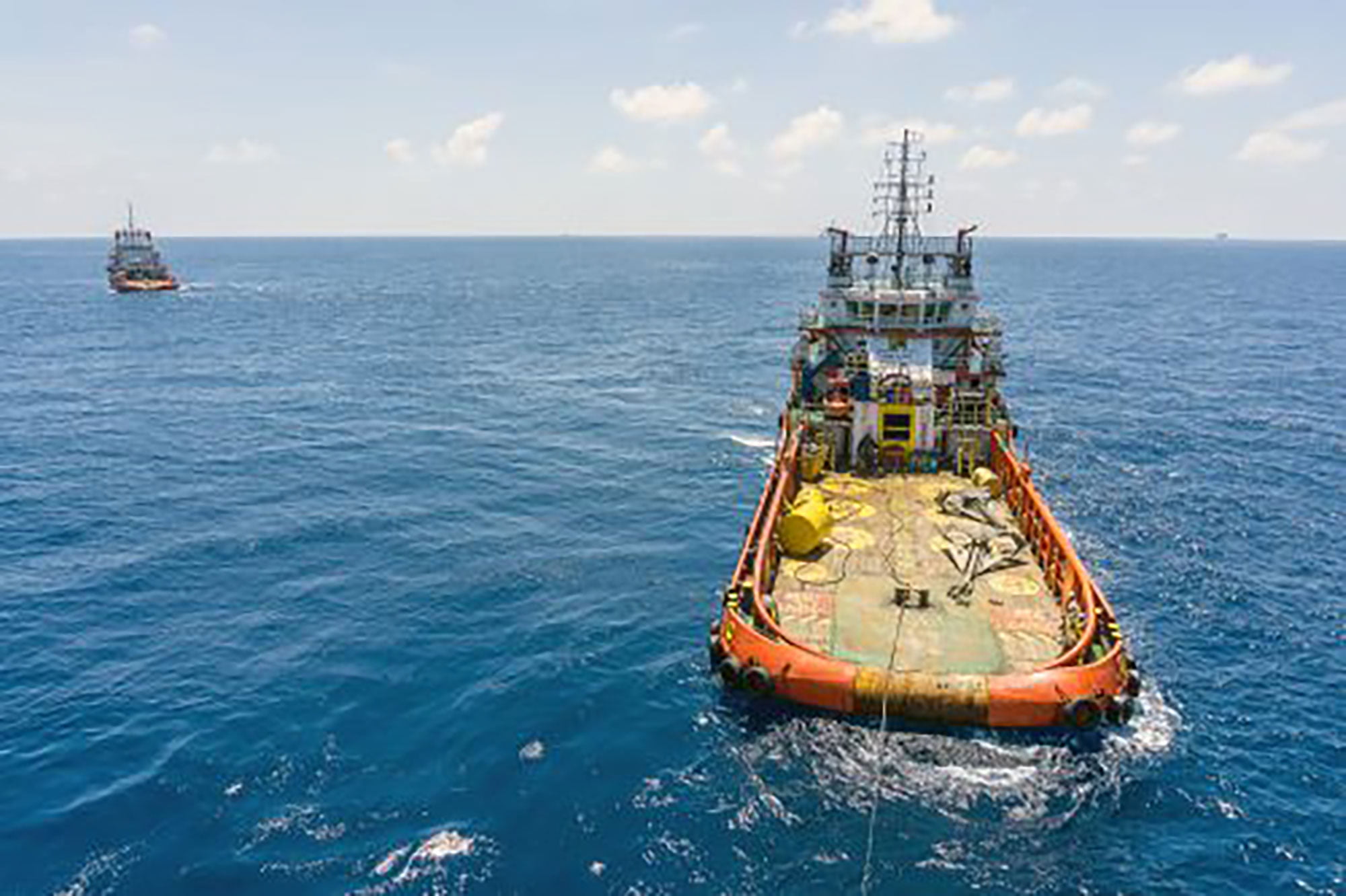
While many employees across different sectors began working remotely, offshore installations continued operating and vessels remained active.
In particular, decommissioning activity in the North Sea has continued at pace. We recently supported a company dismantling one of its major fields. The field consisted of three fixed platforms located approximately 386 km north-northeast of Aberdeen. Each platform stood in water depths of around 120 metres. The site is extremely exposed and regularly experiences waves reaching up to 23 metres.
We first worked with this client when they encountered problems with a temporary navigation light installed on one of their platforms. They needed a rapid and reliable solution.
Access to the platform was only possible at low level, and no lifting equipment was available. Consequently, personnel had to manually move lights, solar panels, batteries, battery boxes and other equipment through the structure in small sections before assembling everything on site.
Our engineers also had to consider the platform’s orientation and areas affected by partial shading. Despite these challenges, the installation proved highly successful. It also provided a significantly more cost-effective solution than the previous system.
Supporting offshore decommissioning
When the client began decommissioning activities, Hydrosphere worked closely with the contractor to supply two Mobilis JET 9000 navigation buoys to mark the site.
The mooring system needed to withstand significant water depths and the extreme environmental conditions found in the Northern North Sea.
Fortunately, we delivered the buoys just before lockdown restrictions came into force in France, ensuring the project remained on schedule.
We are currently supporting another similar project. Due to the short project timescale, we are supplying three ex-rental buoys for deployment in water depths of approximately 90 metres.
The excellent UV resistance of the floats and the high-quality aluminium components provide these buoys with an exceptionally long operational life.
The mooring arrangement includes a heavy sinker positioned on the seabed, substantial lengths of chain and a synthetic mooring line connected to the buoy. This configuration enables the buoys to withstand severe sea states and turbulent offshore conditions.
Increased demand for remote monitoring
Alongside increased activity in the oil and gas sector, Hydrosphere has also experienced growing demand for remote monitoring solutions tailored to individual customer requirements.
Many monitoring systems operate exclusively with their own products. This often forces operators to monitor several independent systems across multiple screens, creating unnecessary complexity.
One of our customers wanted to monitor all navigation lights from a single interface. The manufacturer’s software could not provide this functionality. To overcome this limitation, we introduced our own HydroWatch/HydroData system.
The flexibility of HydroWatch
The key strength of HydroWatch lies in its versatility.
In addition to communicating directly with navigation lights and other equipment through serial ports, the system accepts multiple digital and analogue alarm inputs.
As a result, HydroWatch can collect information from existing third-party systems and generate alerts or trigger automated actions based on several operating conditions.
For example, the system could monitor wind speed and direction from a meteorological station. If wind speeds exceed a predetermined threshold from a specific direction, HydroWatch could automatically generate an alert.
Similarly, if a wave buoy records excessive wave heights, the system could alert operators and automatically activate port closure lights. This functionality helps protect users, particularly outside normal working hours.
HydroWatch can also replace existing control systems or monitor third-party installations.
Current projects include replacing a navigation light control system approaching end-of-life status and monitoring multiple linkspans.
As lockdown restrictions continue to ease, we look forward to resuming postponed projects and supporting new developments.
If you are looking for aids to navigation or remote monitoring solutions for your next project, contact Hydrosphere today to discuss your requirements.
With lockdown starting to ease, we are looking forward to getting back to postponed projects and taking on new ones. If you are looking for aids to navigation or monitoring solutions for your next project, please get in contact today to discuss your requirements.